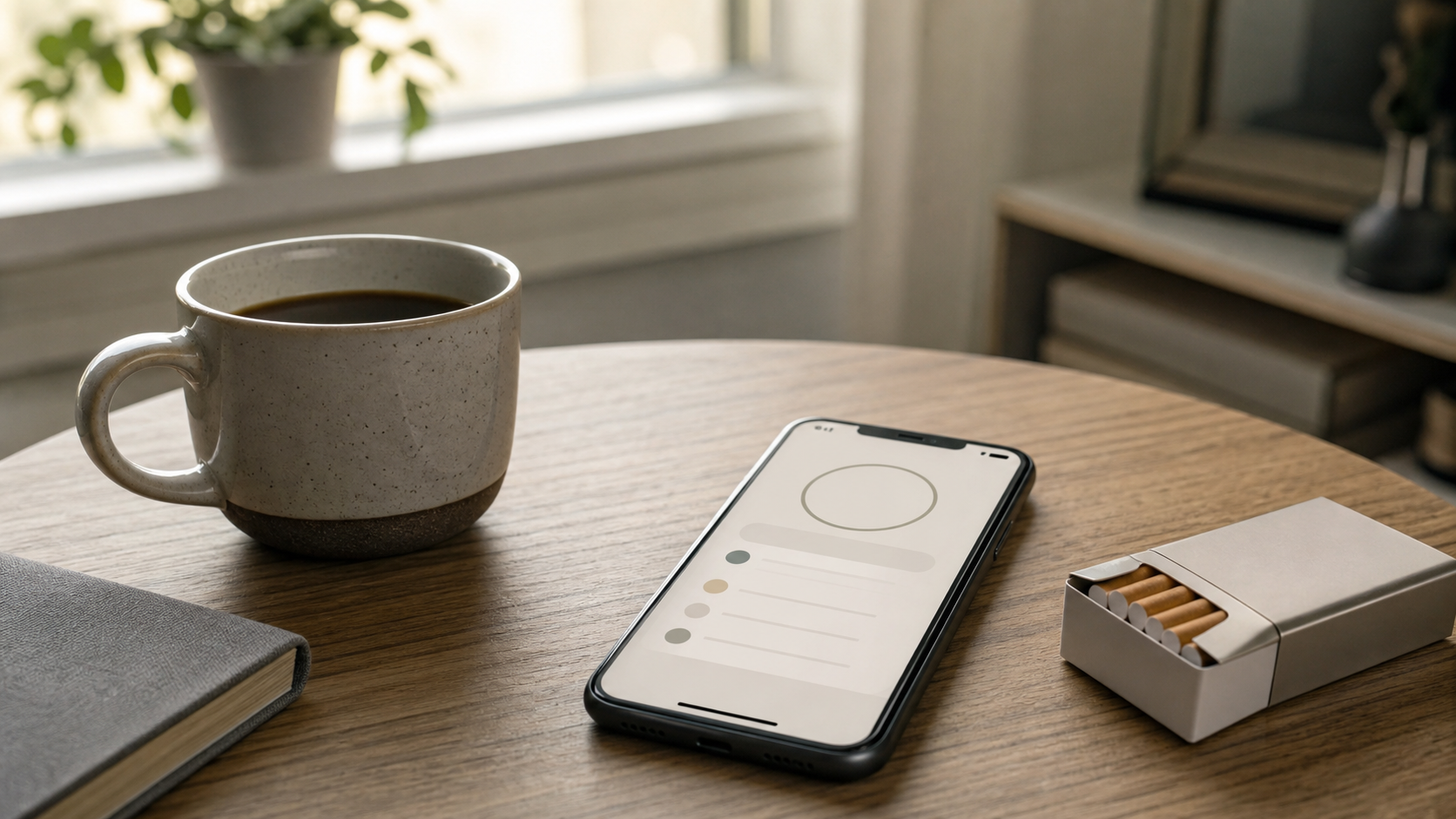
Some mornings, smoking does not feel like a decision.
The coffee is ready. Your phone is on the table. The day has barely started, and your hand already knows where the pack is.
It is not dramatic. It is not a big internal speech that says, “I have decided to smoke.” It is usually smaller than that. A gesture. A routine. Something that happens before you have time to judge it.
That is a better place to start.
Not with the grand promise that you will quit on Monday. Not with shame. Not with another app that makes you feel like you failed because one hard day got messy.
Start with noticing: when does the gesture show up, what sets it off, and how long does it take before the next cigarette?
The Problem With “I’ll Quit Monday”
“I’ll quit Monday” sounds clean. Decisive. Almost satisfying.
Real life is rarely that tidy.
Monday comes with work, coffee, stress, errands, other people, breaks, tiredness, and the little rituals you barely notice anymore. If the first day does not go perfectly, many people feel as if the whole plan is ruined. Then the familiar thought arrives: “If I already smoked one, what’s the point?”
There is still a point.
One cigarette does not erase everything. One difficult day does not cancel your progress. A slip does not have to become a verdict.
The American Cancer Society talks about the importance of strategies and support after quitting because the hard part is not only making the first decision. It is staying oriented when the difficult moments come back.
For some people, the first realistic step is not quitting overnight. It is understanding the habit.
A Habit Has a Setting
Smoking rarely appears alone.
It comes with coffee. A work break. Stress. Driving. Alcohol. Boredom. “I’ll step outside for a minute.” Your phone in your hand. Someone nearby lighting up first.
Smokefree.gov and the NHS both describe smoking triggers as situations, places, emotions, or routines that can set off a craving. Mayo Clinic gives similar practical advice: once you know what triggers a craving, you can plan for that moment instead of meeting it unprepared.
That matters.
Not “I’m weak.”
Not “I have no willpower.”
More like: “Something repeats here.”
Once you can see the repeat, you have somewhere to begin.
What to Track for 7 Days
You do not need to turn this into a medical file. You do not need to fill out ten fields every time you smoke.
Start simple.
Log when you smoked. That is enough. If you can, add the context: coffee, stress, work, social, after a meal, driving, boredom.
After a few days, small truths begin to show up.
Maybe mornings are harder than you thought.
Maybe stressful meetings lead to more cigarettes.
Maybe weekends look completely different from workdays.
Maybe you can delay more easily at night than in the morning.
This is not just “data.” It is a map.
And a good map does not scold you. It shows you where you are.
Why Intervals Matter
If yesterday you smoked after 40 minutes and today you reached 55, something happened there.
It is not a spectacular transformation. It will not make a dramatic before-and-after story. But it is a small space gained between impulse and action.
For someone trying to smoke less, that space can matter.
Maybe today you do not reduce the total number. But you delay the first cigarette by five minutes. Or you wait a little longer after coffee. Or you notice that a craving loses strength if you take a short walk.
CDC recommends simple actions for craving moments: talk to someone, move your body, change the setting, ask for support. MedlinePlus also points to planning, distraction, and small rewards.
None of these are magic tricks. They are small brakes.
Sometimes a small brake is exactly what you need.
What to Do After a Bad Day
This is where many apps get it wrong.
They celebrate you when things go well and make you feel worse when they do not. But anyone who has tried to change a habit knows that bad days are not an exception. They are part of the road.
Maybe you smoked more today. Okay. The useful question is not, “Why did I ruin everything?”
The better question is:
What happened today?
What was the trigger?
When did the chain start?
Where is the next moment where I can add a pause?
That is recovery. Not motivational noise. Not a quote pasted over a real problem. Just a calm return to the next step.
Smoked one? Log it.
Smoked more than one? Log those too.
Not as punishment. As information.
Tomorrow needs today’s data.
Where SmokeLess Fits
That is what we are trying to build with SmokeLess.
Not an app that promises to fix you. Not a loud coach. Not a system that tells you that you failed because one day went badly.
A calm tracker.
You log cigarettes. You see the intervals. You add context. You track triggers. You get a weekly report. If today is above your recent baseline, the app does not shame you. It helps you return to the next interval.
The idea is simple: smoking less often starts with seeing more clearly.
SmokeLess keeps the practical pieces close:
- fast logging;
- trigger tracking;
- intervals between cigarettes;
- weekly progress reports;
- recovery after difficult days;
- local-first data;
- optional backup.
It does not replace medical advice. If you have intense withdrawal symptoms, strong anxiety, health concerns, or you feel you need support, talk to a doctor or a qualified specialist.
But as a daily tool, it can do something useful: it can show you the pattern.
A Simple 7-Day Experiment
Do not change everything on day one.
Just track.
For seven days, log every cigarette. If you can, add the context. At the end of each day, look at one thing only: what moment repeated?
Do not try to solve every trigger. Pick one.
If it is coffee, wait five minutes.
If it is stress, log the craving before lighting up.
If it is the work break, change the route.
If it is the evening, add a tiny rule: “First I drink water, then I decide.”
It does not sound like much. But it is something you can actually do.
And something you can do is worth more than a big promise you abandon by Tuesday.
FAQ
Can a cigarette tracker help me quit smoking?
A tracker will not quit for you. But it can help you see when you smoke, which situations repeat, and where you have the best chance to make a small change.
What are smoking triggers?
Smoking triggers are situations, emotions, places, or routines that can set off the urge to smoke. Common examples include coffee, stress, work breaks, alcohol, driving, boredom, or being around other smokers.
What should I do if I smoke more than planned?
Do not turn the day into a verdict. Log what happened, identify the main trigger, and focus on the next interval. A difficult day can become useful information.
Does SmokeLess replace medical help?
No. SmokeLess is a tracking and reflection tool. If you experience strong symptoms, severe withdrawal, anxiety, or medical concerns, speak with a doctor or a qualified specialist.
Sources
- CDC — Tips for Quitting: https://www.cdc.gov/tobacco/campaign/tips/quit-smoking/tips-for-quitting/index.html
- Smokefree.gov — Know Your Smoking Triggers: https://smokefree.gov/challenges-when-quitting/cravings-triggers/know-your-triggers
- NHS — Understand Your Smoking Triggers and Cravings: https://www.nhs.uk/better-health/quit-smoking/staying-smoke-free/understand-your-smoking-triggers-and-cravings/
- American Cancer Society — Staying Tobacco-free After You Quit: https://www.cancer.org/cancer/risk-prevention/tobacco/guide-quitting-smoking/staying-tobacco-free-after-you-quit-smoking.html
- Mayo Clinic — Resist Tobacco Cravings: https://www.mayoclinic.org/diseases-conditions/nicotine-dependence/in-depth/nicotine-craving/art-20045454
- MedlinePlus — Dealing with Cravings: https://medlineplus.gov/ency/patientinstructions/000854.htm