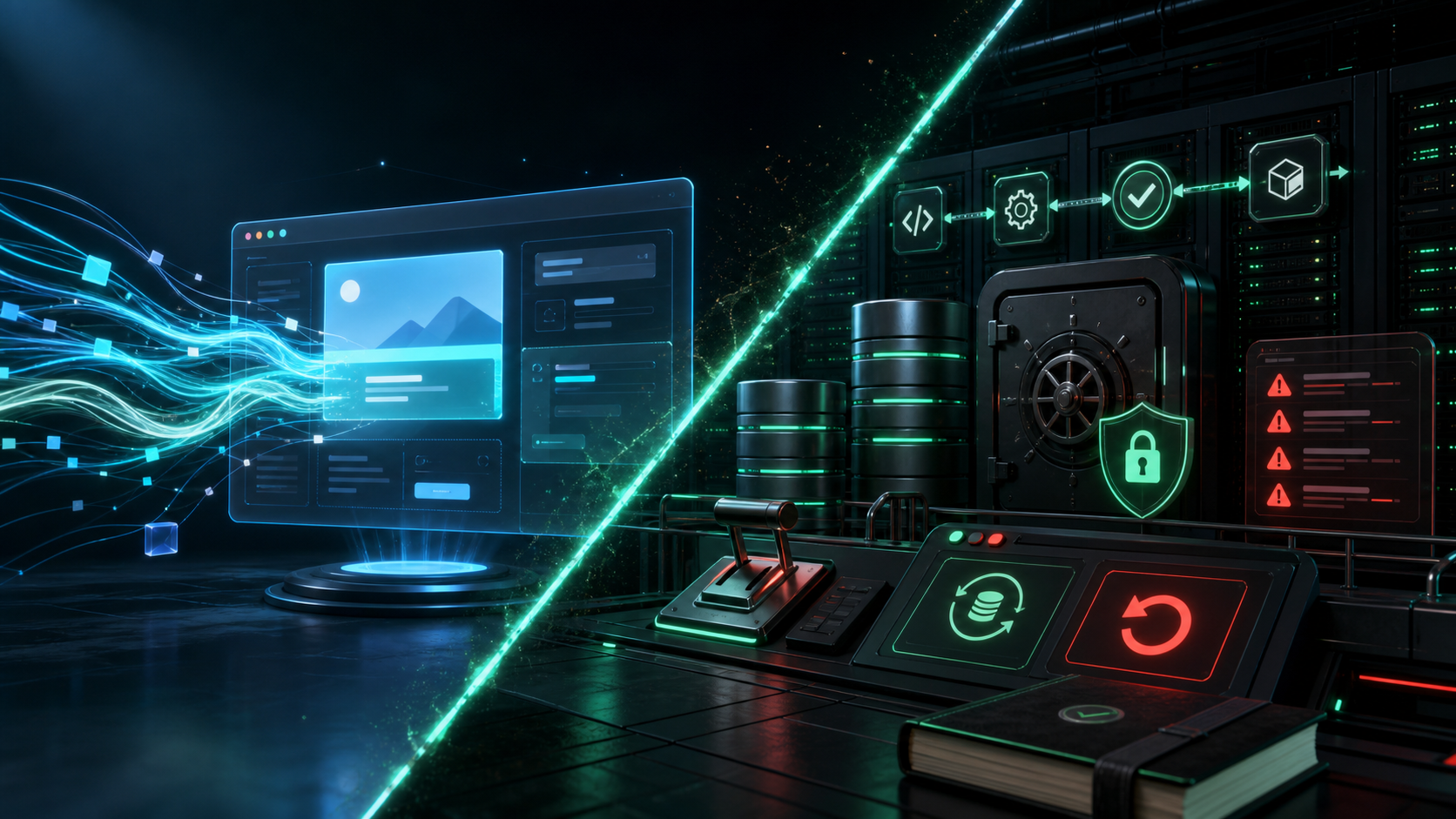
AI can build a demo in minutes, and that changes how software products begin. An idea that once needed a developer, a designer, a few days of setup, and a fair amount of patience can now turn into a working interface before you have time to overthink it.
For prototypes, that is genuinely useful.
The problem starts when the demo is treated like a product. Once the app has authentication, a real database, users, tokens, passwords, .env files, production deploys, backups, rollbacks, and data that cannot be lost, the speed at which the code was written stops being the most important thing. Suddenly, what matters is what happens when a migration is wrong, when a secret ends up in the wrong place, when an agent has permissions that are too broad, or when a deployment fails halfway through.
That is where the impressive part ends.
And software begins.
Demos Forgive Almost Anything
In a demo, mistakes are cheap. If an AI agent generates the wrong route, you prompt again. If the interface breaks, you rebuild the component. If the database is messy, you wipe it and start over. That rhythm feels good because everything seems instantly fixable.
Production does not work that way.
A bad migration can touch real data. A misplaced token can open access to internal systems. A route that "looks private" but does not check ownership can expose one user's data to another user. It does not need to be a cinematic disaster; many serious problems begin as one small assumption that nobody verified.
That is the gap that the hype around vibe coding sometimes hides. The problem is not that AI can write code. The problem is that a real product is not just code that runs.
Code Got Cheaper. Responsibility Did Not.
Over the last year, the conversation around AI coding has moved from autocomplete to agents. We are no longer talking only about a model that suggests a function. We are talking about systems that can edit files, run commands, create pull requests, read errors, rerun tests, and, in some setups, get very close to deployment.
That changes the risk.
A chatbot that gives a wrong answer can mislead someone. An agent with access to a terminal, repository, database, or internal tools can create direct effects. The difference between "it said the wrong thing" and "it did the wrong thing" is huge, and security teams are starting to treat AI agents less like chat interfaces and more like software operators.
That is the real tension: AI can increase the speed at which code is produced, but it does not automatically increase a team's ability to review, secure, and operate that code. If you used to write ten changes a day and now you can generate fifty, your review process does not magically become five times better. In many cases, it just becomes more crowded.
Vibe Coding Should Not Be Dismissed. It Should Be Framed.
It would be a mistake to treat vibe coding as a joke. For many products, it is the best way to start. It helps you see whether the idea makes sense, test a flow, discover what is missing, and avoid spending two weeks on architecture before there is anything usable.
But a fast beginning is not the same as a safe ending.
A prototype can be built through conversation, instinct, and fast iteration. A production system needs more boring rules: backups before migrations, rollback plans, secrets outside the repository, tokens with minimum required permissions, automated tests, smoke tests after deployment, logs for important actions, and a clear separation between local, staging, and production.
None of that looks great in a short demo video.
Still, that is exactly what decides whether an application can survive after real people start using it.
The Trap Is When the App "Looks Done"
The riskiest AI-built apps are not always the ones that look broken. Often, the risk begins when everything looks surprisingly good: the page loads, the form saves, the dashboard looks decent, login works, and the buttons visibly do something.
For an early product, that feeling is hard to resist. It is tempting to say, "It works. Let's ship it and clean things up later."
But the most important parts are often invisible in the interface. You cannot immediately see whether rate limiting exists. You cannot see whether one user can access another user's data. You cannot see whether the backup can actually be restored. You cannot see whether the AI agent that changed something left a useful log. You cannot see whether the deployment has a real path back.
AI can make a product look finished before the system is ready.
That is the dangerous part.
A Simple Checklist Before Production
If an AI-built app is about to touch users, money, or private data, it is worth pausing before deployment. Not for a philosophical debate. For a practical check.
Is there a backup before every migration?
Can you roll back without rebuilding everything from memory?
Are you sure there are no secrets in the repository?
Do tokens have only the permissions they actually need?
Do private routes check both authentication and ownership?
Are tests running before deployment?
Is there a smoke test after deployment?
Are AI actions logged?
If the agent loses context, can someone else continue without guessing?
That last question sounds less technical, but it becomes important during real work. Agents do not fail only when they write bad code. They also fail when they leave behind a state that nobody can continue from: modified files, a long conversation, unclear decisions, partially run tests, and no reliable record of what actually happened.
In a demo, that is annoying.
In production, it is operational risk.
The Future Is Not AI vs Developers
The question "Will AI replace developers?" gets attention, but it misses a more interesting shift. If AI lowers the cost of writing code, then the value moves toward the people and systems that know how to turn that code into stable software.
In other words, the work moves up a level.
It is no longer only about who can write the function. It is about who can set limits for the agent, define permissions, review changes, protect data, run deployments with rollback, and keep a clear trail of decisions.
Speed without discipline is not a competitive advantage. It is just a faster way to reach bigger problems.
Vibe coding is an excellent way to start. But if the application has users, data, money, or secrets, the question is no longer just "does it work?"
The question becomes: can it be verified, continued, repaired, and rolled back if something goes wrong?
That is where the difference between a good demo and a real system begins.